When Torah Became the Only Knowledge: The Argument Against Secular Learning: Volume I
From Defensive Piety to Intellectual Contraction in the Last Three Centuries of Orthodox Jewish Life

Introduction
One of the most consequential distortions in parts of recent Orthodox Jewish life has been the transformation of Torah supremacy into Torah exclusivity. The first proposition is classical and defensible: Torah stands at the center of Jewish existence. The second proposition is much more radical: all meaningful knowledge is already contained in Torah, and therefore science, philosophy, history, literature, medicine, psychology, mathematics, and higher secular education are at best utilitarian distractions and at worst spiritual poison. That second proposition is often presented as if it were ancient Judaism. It is definitely not.
The Talmudic and medieval Jewish worlds were not intellectually narrow civilizations. Chazal discussed astronomy, medicine, agriculture, law, language, commerce, psychology, and politics with remarkable curiosity. The Geonim wrote in Arabic and engaged Islamic philosophy. Saadia Gaon wrote philosophical theology. The Rambam was a physician, philosopher, logician, astronomically literate thinker, and supreme halachist. Rabbeinu Avraham ben HaRambam explicitly defended the use of scientific knowledge. The Ramban knew medicine and natural philosophy. The Ralbag (Gershonides) was a mathematician and astronomer. The Maharal, despite his criticism of certain forms of philosophy, was deeply intellectually ambitious. The Vilna Gaon studied mathematics, astronomy, grammar, and geometry. Rav Shimshon Raphael Hirsch turned worldly culture into a religiously disciplined project. Rav Kook read widely and absorbed European philosophy, poetry, nationalism, and mysticism into a vast religious synthesis.
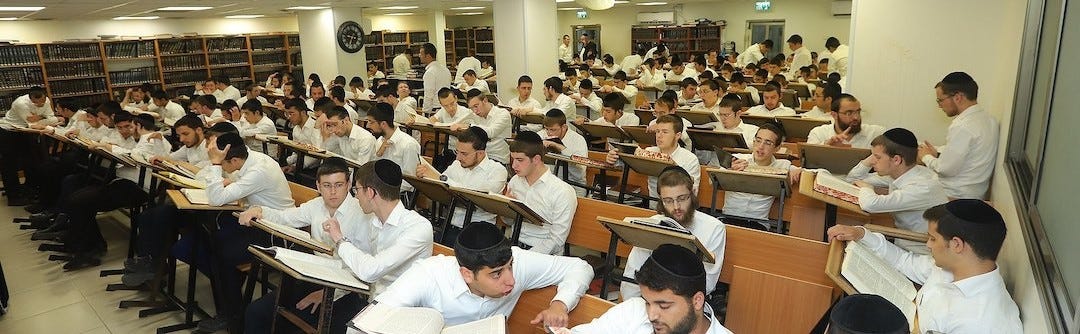
Yet beginning in the eighteenth and nineteenth centuries, and then intensifying after the Haskalah, emancipation, secular nationalism, socialism, Zionism, mass assimilation, and the Holocaust, a counter-ideology hardened inside parts of the Orthodox world. Secular knowledge was no longer treated merely as secondary to Torah. It became suspect. The university became dangerous. Literature became contamination. History became heresy. Science became useful only when it could be subordinated to rabbinic authority. And in some circles, the slogans became sweeping: all wisdom is in Torah; secular studies are bittul Torah; outside knowledge corrupts; universities destroy faith; the only safe education is Torah alone.
Some of the men who said these things were true talmidei chachamim. Some were heroic rebuilders after catastrophe. Some were reacting to real dangers. But greatness in Torah does not make every sociological judgment correct. Nor does spiritual sincerity turn intellectual overreach into truth.
This essay catalogues major rabbinic figures and movements from the last roughly 300 years that contributed to the anti-secular-learning current. It gives biographical context, representative positions, and historical significance. The purpose is not to deny their stature in Torah. It is to show how a defensive posture became an ideology, and how that ideology narrowed Jewish intellectual life.
A note on method is necessary. Many of the most extreme statements circulate in paraphrase, in biographies, in yeshiva oral culture, in institutional polemics, or in later summaries of Hebrew and Yiddish writings. Where an exact quotation is not being given, the language below identifies a “representative position” rather than pretending that every formulation is a verbatim line. That distinction matters. Polemic must be honest.
The Chasam Sofer, Rabbi Moshe Sofer (1762–1839, Pressburg/Bratislava)
Rabbi Moshe Sofer, known as the Chasam Sofer, was born in Frankfurt am Main in 1762 and became one of the dominant halachic authorities of nineteenth-century Central European Orthodoxy. He eventually served as rabbi of Pressburg, today Bratislava, where he built one of the most important yeshivot in Europe. His students became rabbinic leaders throughout Hungary, Slovakia, Austria, and beyond. He lived at the moment when European Jewry was being transformed by emancipation, Reform, the Haskalah, secular education, and the collapse of older communal authority.
The phrase most associated with the Chasam Sofer is “chadash asur min haTorah”, “the new is forbidden by the Torah.” In its original halachic setting, the phrase refers to the biblical prohibition of eating new grain before the omer offering. The Chasam Sofer turned it into a broader slogan against religious innovation. It became one of the most powerful anti-modernist slogans of its time.
To be fair, the Chasam Sofer was by no means an ignoramus nor a primitive anti-intellectual. He was a brilliant halachist, a communal strategist, and a leader fighting what he saw as the dissolution of authentic Judaism. But the broader ideological effect of his slogan was enormous. It gave later Orthodox anti-modernists a powerful rhetorical weapon: if something was new, it could be treated as suspect simply because it was new.
This was not yet the full Torah-only ideology of later Chareidi culture. But it was a major foundation stone. It encouraged the idea that modernity itself was spiritually dangerous and that preservation required suspicion toward outside intellectual currents.
Rabbi Hillel Lichtenstein of Kolomyia (1815–1891, Galicia and Hungary)
Rabbi Hillel Lichtenstein was born in Večká, in the Hungarian lands, and became one of the fiercest anti-modernist rabbis of the nineteenth century. He served in several rabbinic posts, including Kolomyia, and became a central figure in the radical Hungarian Orthodox reaction against Reform, moderate Orthodoxy, secular schooling, vernacular sermons, changes in dress, and modern communal institutions.
His background is crucial. Hungarian Jewry in the nineteenth century was split by intense conflict between Neolog modernizers, moderate Orthodox leaders, and the more separatist ultra-Orthodox camp. Rav Lichtenstein represented the militant wing. He believed that compromise with modernity was not prudence but betrayal.
His representative position was stark: separation from modern culture was not merely advisable but religiously necessary. Secular education, vernacular acculturation, and modern dress were viewed as gateways into religious collapse. He helped make social insulation itself into a form of piety.
His importance lies less in one famous quote than in the model he helped create: the rabbi as guardian against modernity, not merely against heresy; the community as fortress; cultural separation as a religious ideal. This mentality would strongly influence later Hungarian ultra-Orthodoxy, including the world from which Satmar emerged.
Rabbi Akiva Yosef Schlesinger (1837–1922, Hungary and Jerusalem)
Rabbi Akiva Yosef Schlesinger was born in Pressburg into the Hungarian Orthodox world shaped by the Chasam Sofer’s legacy. He later moved to Jerusalem and became known for his radical separatist ideology. His book Lev HaIvri became a manifesto of extreme anti-modern Orthodoxy.
Schlesinger’s background combined Hungarian anti-Reform zeal with messianic longing for settlement in the Land of Israel. Unlike the later Satmar ideology, he was not anti-settlement of the land of Israel. But he was intensely opposed to modern cultural influence. He advocated strict separation from non-Orthodox Jews, retention of traditional dress, resistance to secular languages, and opposition to modernizing trends.
His representative position was that the Jewish people could survive only through radical separation from the modern world. He attacked secular studies and vernacular culture because he saw them as the channels through which the Jewish soul was being dissolved.
Schlesinger matters because he shows that not all anti-modernism led to anti-Zionism, and not all settlement-oriented religious Jews were intellectually open. His model was restoration without modernity: Jewish return stripped of modern national, scientific, and intellectual engagement.
Rabbi Yisrael Meir Kagan: The Chafetz Chaim (1838–1933, Radin, Poland)
Rabbi Yisrael Meir Kagan, the Chafetz Chaim, was born in 1838 in Belarus and became one of the most beloved rabbinic figures of modern Jewish history. He lived in Radin, in what was then the Russian Empire and later Poland. He wrote Chafetz Chaim on the laws of speech, the Mishnah Berurah on Orach Chaim, Shemirat HaLashon, and numerous works of ethics and halacha.
He was not a political theorist in the modern sense. He was a moralist, halachist, and saintly communal figure living through the collapse of Eastern European traditional society. The late nineteenth and early twentieth centuries saw Jews leaving observance in massive numbers through socialism, Bundism, Zionism, secular Hebrew culture, Russian education, and migration to America.
The Chafetz Chaim’s representative position was that secular culture posed an extreme spiritual danger. He urged Jews to strengthen Torah learning, yeshivot, modesty, halachic observance, and communal separation from corrosive influences.
His warnings should be understood as emergency rhetoric. He saw a burning house. But unfortunately emergency rhetoric can become permanent ideology. Later Chareidi education inherited his fear of outside culture but often stripped it of his humility, moral refinement, and practical sensitivity. The Chafetz Chaim was not the source of crude anti-scientific slogans. But he helped sanctify the posture of cultural defensiveness that later made those slogans easier to accept.
Rabbi Elchonon Wasserman (1874–1941, Lithuania and Poland)
Rabbi Elchonon Wasserman was born in 1874 and became one of the great Lithuanian roshei yeshiva before the Holocaust. A student of the Chafetz Chaim, he headed the yeshiva in Baranovitch and wrote Kovetz Shiurim and other works. He was murdered by the Nazis in 1941.
His background was the militant mussar-infused Lithuanian yeshiva world of the interwar period. He watched secular ideologies seize the Jewish imagination: communism, socialism, nationalism, Zionism, and liberalism. To him these were not neutral intellectual options. They were spiritual seductions.
In writings such as Ikveta deMeshicha, he attacked secular ideologies and interpreted Jewish political and cultural crises through a religious lens. He was intensely critical of secular Zionism and modern Jewish unbelief. His representative position was that secular ideologies were not merely mistaken but rooted in rebellion against divine authority. In this climate, secular knowledge was rarely seen as innocent. It was bundled together with kefirah, ideological seduction, and loss of faith.
Rabbi Elchonon’s tragic death gave his writings immense posthumous authority. But tragedy does not settle intellectual questions. His witness to Jewish catastrophe was powerful. His interpretation of modernity was not the only possible Jewish interpretation.
Rabbi Avraham Yeshaya Karelitz: The Chazon Ish (1878–1953, Lithuania and Bnei Brak)
The Chazon Ish was born in Kosava in 1878 and became one of the most influential rabbinic authorities of the twentieth century. He lived in Lithuania and later moved to Eretz Yisrael in 1933, settling in Bnei Brak. He wrote major works under the title Chazon Ish on many areas of Talmud and halacha. He never held a formal rabbinic post, but his authority in the emerging Israeli Chareidi world was immense.
His biography matters because he became the bridge between prewar Lithuanian Torah culture and postwar Israeli Chareidi reconstruction. After the Holocaust, the old Torah world had been nearly destroyed. The Chazon Ish helped rebuild it in Palestine/Israel under radically changed conditions: a secular Zionist state, a traumatized remnant, poverty, ideological conflict, and a desperate desire to recreate lost worlds.
The representative position associated with the Chazon Ish is the supremacy and near-total sufficiency of Torah learning as the foundation of Jewish life. He distrusted secular Zionist culture, academic Jewish studies, and modern ideological movements. He believed the yeshiva world had to be rebuilt with uncompromising intensity.
This is where the emergency became a system. Full-time Torah study, originally an elite vocation, became an expanding communal ideal. Secular studies were not merely reduced; they were morally demoted. The ben Torah became the center of the universe. The worker, professional, scientist, physician, engineer, historian, or soldier became secondary.
The Chazon Ish was a towering halachic mind. But the society built from his ideological orbit often confused reverence for Torah with suspicion of the world.
The Brisker Rav: Rabbi Yitzchok Zev Soloveitchik (1886–1959, Brisk and Jerusalem)
Rabbi Yitzchok Zev Soloveitchik, the Brisker Rav, was born in Volozhin in 1886 into the Soloveitchik dynasty. He was the son of Rabbi Chaim Brisker and became rabbi of Brisk. After escaping Europe during the Holocaust, he settled in Jerusalem, where he became one of the defining figures of the anti-Zionist Lithuanian-Chareidi world.
His background was aristocratic Lithuanian Torah brilliance: intense, analytical, suspicious of compromise, and shaped by the Brisker method of conceptual Talmudic analysis. Unlike his nephew, the Rav, Rabbi Joseph B. Soloveitchik, who became a master of both Torah and Western philosophy, the Brisker Rav represented a far more separatist model.
His representative position was that Torah must be protected from ideological compromise and that the secular Zionist project represented profound spiritual danger. His circle was deeply suspicious of state institutions, modern culture, and non-Torah intellectual frameworks.
The Brisker Rav did not produce a mass educational platform in the same way as the Chazon Ish or Rav Shach, but his symbolic power was enormous. He embodied the aristocratic refusal to bend. That posture helped shape the later Chareidi instinct that intellectual purity required distance from secular knowledge.
Rabbi Yosef Shlomo Kahaneman: The Ponevezher Rav (1886–1969, Lithuania and Bnei Brak)
Rabbi Yosef Shlomo Kahaneman was born in 1886 in Kuhl, Lithuania. He studied in major Lithuanian yeshivot and became rabbi of Ponevezh. After the destruction of Lithuanian Jewry, he rebuilt the Ponevezh Yeshiva in Bnei Brak, turning it into one of the flagship institutions of the postwar Torah world.
The Ponevezher Rav was not a narrow man. He was energetic, institutionally brilliant, emotionally expansive, and capable of dealing with politicians and secular leaders. Yet the institution he rebuilt became part of the larger Israeli Chareidi educational system in which secular studies were sharply devalued.
His representative position was less anti-science polemic than total commitment to rebuilding Torah. The point was not to argue with biology or literature; the point was to recreate Slabodka, Ponevezh, and Lithuania after the Nazis had destroyed them.
This is an important category. Not every contributor to Torah-only culture was a dogmatic anti-intellectual. Some were builders whose priorities were so focused on Torah reconstruction that everything else simply disappeared from view. The long-term result, however, was similar: a society in which general knowledge became peripheral or suspect.
The Satmar Rebbe: Rabbi Yoel Teitelbaum (1887–1979, Hungary, Romania, Williamsburg, Kiryas Joel)
Rabbi Yoel Teitelbaum was born in 1887 in Sighet, then in the Austro-Hungarian Empire. He became associated with Satmar, served in several rabbinic posts, survived the Holocaust, and rebuilt his Chasidic court in Williamsburg, Brooklyn. He later became the founding ideological force behind Kiryas Yoel in upstate NY. He died in 1979.
His background was Hungarian ultra-Orthodoxy at its most separatist. This was not the Lithuanian yeshiva suspicion of secular learning. It was a broader civilizational rejection of modernity: secular education, Zionism, modern Hebrew culture, state power, acculturation, and non-traditional dress.
His major ideological work, Vayoel Moshe (1959), turned the Talmudic aggadah of the Three Oaths into a comprehensive anti-Zionist theology. In his system, secular Zionism was not simply a political mistake but a rebellion against God. He argued that Zionism contributed to divine punishment and delayed redemption.
His representative position regarding secular knowledge was embedded in this larger anti-modernism. Modern culture was spiritually contaminating. Secular education was dangerous. The safe Jewish life required maximal separation.
The Satmar Rebbe’s influence was enormous because he did not merely oppose secular studies; he built an entire communal civilization around insulation. Language, clothing, schooling, marriage patterns, political behavior, newspapers, and communal institutions were all mobilized against modern influence.
One can understand the trauma behind his worldview while still saying plainly that his theology turned historical catastrophe into ideological ammunition and narrowed Jewish life into a fortress.
Rabbi Eliyahu Eliezer Dessler (1892–1953, Lithuania, England, and Israel)
Rabbi Eliyahu Eliezer Dessler was born in 1892 in Gomel and was shaped by the Lithuanian mussar world of Kelm. He later lived in England, where he influenced Gateshead, and eventually moved to Israel, where he became mashgiach ruchani at the Ponevezh Yeshiva. His teachings were collected in the sefer, Michtav MeEliyahu.
Rav Dessler is one of the most sophisticated figures in this listing. He was not a crude obscurantist. He knew Western thought, understood psychology, and wrote with philosophical depth. Precisely for that reason, his anti-secular-learning statements became influential. He had encountered the outside world and still warned against it.
He criticized the Hirschian model of Torah im Derech Eretz when transplanted into the Eastern European yeshiva world. In his view, secular studies could not safely fertilize Torah life for most people; they were too likely to become independent sources of values. External wisdom might be used instrumentally, but it should not shape a Jew’s worldview.
The representative position is that secular knowledge is dangerous not because every fact is false, but because secular culture forms the imagination. That is a more subtle and serious argument than simple anti-intellectualism. But its practical effect in the yeshiva world was still contraction: suspicion of broad education, fear of literature and philosophy, and hostility toward university culture. Rav Dessler matters because he gave anti-secularism intellectual elegance. He made retreat sound profound.
Rabbi Aharon Kotler (1891–1962, Slutsk, Kletsk, Lakewood)
Rabbi Aharon Kotler was born in 1891 in Svislovitz and studied in Slabodka. He became rosh yeshiva in Kletsk and later escaped Europe during the Holocaust. In 1943 he founded Beis Medrash Govoha in Lakewood, New Jersey, which became the central institution of the American Lithuanian yeshiva world.
His background was elite Lithuanian Torah scholarship combined with post-Holocaust urgency. He came to America at a time when Orthodox Judaism was weak, immigrant Judaism was often collapsing, and higher education was becoming the path to American integration.
Rav Aharon’s representative position was that Torah learning must be pursued with total devotion and that America needed a real yeshiva culture, not merely observant professionals. He created the American kollel model and insisted that elite Torah study could survive even in the United States.
This was historically heroic. Without Rav Aharon Kotler, American Torah learning would likely have been far weaker. But the model also helped normalize the idea that long-term full-time Torah study should be not only for exceptional scholars but for a much larger social class.
In Lakewood’s later development, this ideal expanded into an entire communal economy. Secular education was minimized. College was often discouraged. Professional preparation was delayed or treated as a concession. The highest form of life became yeshiva study insulated from the broader intellectual world. Rav Aharon himself was building an elite rescue operation. Later society turned it into a mass template.
Rabbi Elazar Menachem Man Shach (1899–2001, Lithuania and Israel)
Rav Shach was born in 1899 in Vaboilnik, Lithuania. He studied in Ponevezh, Slutsk, and other yeshivot, survived the upheavals of war, and eventually became rosh yeshiva of Ponevezh in Bnei Brak. By the late twentieth century, he was the dominant ideological leader of the Lithuanian Chareidi world in Israel and founder of the Degel HaTorah political movement.
His background was pure Lithuanian yeshiva culture: Talmudic analysis, suspicion of secular Zionism, opposition to Chasidic political dominance, and a fierce commitment to Torah authority. He lived long enough to shape not merely students but parties, newspapers, schools, and communal policy.
Rav Shach made some of the sharpest modern Chareidi statements against secular studies. In writings and speeches collected in Michtavim U’Ma’amarim, he attacked secular education, universities, history, psychology, and modern cultural study as spiritually dangerous. Summaries of his position report that he regarded secular education at any level as forbidden and described certain disciplines, especially history and psychology, in terms associated with heresy. Whether every popular paraphrase is exact or exaggerated, the broad position is unmistakable: secular studies were not neutral. They were threatening.
Rav Shach’s significance is enormous because he transformed anti-secular suspicion into communal policy. Under his influence, the Israeli Lithuanian world developed a mass kollel society, minimized secular curriculum for boys, opposed academic study, and treated the university as a site of spiritual danger. This was not merely an opinion. It became an educational system.
Rabbi Yaakov Yisrael Kanievsky: The Steipler Gaon (1899–1985, Hornostaypil and Bnei Brak)
The Steipler was born in 1899 in Hornostaypil, Ukraine, and became one of the great Lithuanian rabbinic figures of Bnei Brak. He was the brother-in-law of the Chazon Ish and father of Rabbi Chaim Kanievsky. His major work, Kehillot Yaakov, is a monumental set of Talmudic analyses.
His background was one of poverty, intensity, asceticism, and total immersion in Torah. He became a model of saintly detachment from worldly ambition. The representative position associated with the Steipler was that a young man’s highest calling is Torah learning and that secular ambition must not be allowed to interfere with spiritual growth. In letters and guidance, he strongly encouraged yeshiva study and warned against influences that could weaken faith.
The Steipler was less a polemical theorist than an embodiment of the ideal. His life taught that Torah alone was enough. His authority helped reinforce the social expectation that serious boys should remain in learning as long as possible. Again, the problem is not personal greatness. The problem is social translation. An ascetic genius can live that way. A whole society cannot easily do so without economic, educational, and civic consequences.
The Rebbe: Rabbi Menachem Mendel Schneerson (1902–1994, Ukraine, Berlin/Paris, Brooklyn)
The Lubavitcher Rebbe was born in 1902 in Nikolaev, Ukraine. He studied in Europe, spent time in Berlin and Paris, had exposure to mathematics, engineering, and science, escaped Nazi Europe, and became the seventh Chabad Rebbe in Brooklyn in 1951.
He is complicated because he was not ignorant of secular knowledge and did not teach simple anti-scientific obscurantism. He corresponded with scientists, physicians, and engineers, encouraged technological outreach, and used modern communications with extraordinary effectiveness.
At the same time, Chabad discourse often includes the claim that Torah contains all wisdom and that secular knowledge is ultimately subordinate to Torah. The Rebbe sometimes encouraged secular study when needed for livelihood or shlichus, but the hierarchy remained absolute: Torah is the source, secular wisdom is derivative, instrumental, or valuable only when used for divine service.
This is a more refined form of the “all wisdom is in Torah” claim. It is not the same as Rav Shach’s blunt hostility to university study. But it can still produce intellectual distortion when followers treat science as something to be validated only after it fits Torah rhetoric. The Rebbe’s own breadth prevented crude narrowness. The problem is what happens when followers inherit the slogans without the breadth.
However, in my view, the Rebbe’s arguments against evolution were scientifically unconvincing and reflected a misunderstanding of how modern empirical science builds knowledge through converging evidence across multiple disciplines. One does not strengthen Torah by forcing it into unnecessary conflict with overwhelming evidence from genetics, paleontology, molecular biology, and evolutionary theory.
Rabbi Michoel Ber Weissmandl (1903–1957, Slovakia and Mount Kisco): Torah Codes and the Temptation of Totality
Rabbi Michoel Ber Weissmandl was born in 1903 in Debrecen, Hungary, became associated with Nitra, and later founded the Nitra Yeshiva in Mount Kisco, New York. He is remembered heroically for rescue efforts during the Holocaust and for his Torah scholarship.
He is included here not as a simple anti-secular-learning figure, but because of a different intellectual tendency: the belief that hidden structures within Torah contain vast knowledge. He became associated with early forms of Torah code analysis, searching for equidistant letter patterns in the Torah text.
This is not the same as saying secular disciplines are forbidden. But it contributes to the broader mentality that Torah contains all knowledge in encoded form. Once that idea becomes popularized, it can easily become anti-intellectual: why study history, biology, linguistics, or mathematics seriously if the Torah already contains everything?
The deeper issue is epistemological. Reverence for Torah becomes confused with the fantasy that Torah replaces disciplined investigation.
Rabbi Avigdor Miller (1908–2001, Baltimore, Slabodka, New York)
Rabbi Avigdor Miller was born in Baltimore in 1908, studied in New York and then in the Slabodka Yeshiva in Europe, and became a prominent American Chareidi rabbi, lecturer, and author. He served for decades in Brooklyn and became famous for his prolific tapes, books, and forceful public lectures.
His background combined American upbringing with Lithuanian mussar training. He spoke English fluently, understood American culture, and used modern media to reach broad audiences. Yet he preached a fierce distrust of secular culture, evolution, universities, liberalism, and non-Torah intellectual frameworks.
His representative position was that the secular world is saturated with falsehood, immorality, and anti-Torah assumptions. He often insisted that true wisdom is found in Torah and that modern academic culture is spiritually corrupt.
Rabbi Miller’s influence was enormous among English-speaking Orthodox Jews because he translated anti-secular Chareidi instincts into American idiom. He was blunt, confident, and rhetorically powerful. He made suspicion of the university sound like common sense.

His weakness was that his polemical style often flattened complex disciplines into caricature. He saw the dangers of secular culture clearly, but he too often treated entire fields of knowledge as though they were nothing more than atheistic propaganda.
My Response to Avigdor Miller
More fundamentally, Rabbi Miller’s worldview most often reflected an extraordinary level of intellectual overconfidence. He spoke not merely as a defender of Torah values against the moral excesses of modernity, but as though vast domains of science, philosophy, history, psychology, and higher learning could be dismissed with sweeping declarations and rhetorical certainty. That posture becomes especially problematic when one considers that modern civilization, including medicine, engineering, transportation, communications, agriculture, and countless technologies that preserve and enhance human life, emerged from precisely the scientific and intellectual traditions he so frequently disparaged. The irony is striking: a rabbi using microphones, printing presses, recorded tapes, antibiotics, electricity, and modern infrastructure while simultaneously portraying the intellectual ecosystems that produced those achievements as fundamentally corrupt or worthless. One can vigorously criticize aspects of secular culture without reducing centuries of human inquiry into a cartoon of atheism and decadence. The Torah world does itself no favor when it presents intellectual isolation as a virtue or when complex disciplines are condemned by individuals who often lacked serious training in those fields. There is a profound difference between recognizing the moral dangers of modern culture and declaring oneself qualified to dismiss the accumulated knowledge of entire civilizations.
Rabbi Aharon Leib Shteinman (1914–2017, Brest, Switzerland, and Bnei Brak)
Rabbi Aharon Leib Shteinman was born in Brest-Litovsk in 1914, escaped wartime Europe through Switzerland, and eventually became one of the leading Lithuanian Chareidi authorities in Israel. He led yeshivot and later became a central communal authority after Rav Shach.
His background was Lithuanian yeshiva austerity combined with personal poverty and modesty. Compared with some other leaders, he was often seen as pragmatic and less rhetorically extreme. Yet he still operated within the Torah-only ideological framework.
His representative position was that yeshiva boys should remain devoted to Torah learning and avoid secular education unless necessity demanded otherwise. He opposed broad academic integration for the Chareidi public, although he sometimes navigated practical realities with more nuance than his predecessors.
His importance lies in the normalization of the system. By his era, the mass kollel model and minimal secular education for boys were no longer emergency measures. They were the default structure of much of Israeli Lithuanian Chareidi life. That is the sociological turning point. A radical idea had become ordinary.
Rabbi Chaim Kanievsky (1928–2022, Pinsk and Bnei Brak)
Rabbi Chaim Kanievsky was born in Pinsk in 1928 and moved to Eretz Yisrael as a child. He was the son of the Steipler and nephew of the Chazon Ish. He became one of the most widely revered rabbinic figures in the late Israeli Chareidi world, known for encyclopedic Torah knowledge, relentless learning discipline, and terse responses to halachic and personal questions.
His background was almost entirely within the Bnei Brak Torah aristocracy. He became a living symbol of Torah absorption. His daily learning schedule and knowledge of obscure rabbinic texts became legendary.
The representative position associated with him was the radical priority of Torah learning over all else. He frequently advised continued learning, discouraged academic paths for yeshiva students, and became a symbolic authority for a society that viewed Torah study as the supreme vocation. Rabbi Chaim Kanievsky’s personal discipline was extraordinary. But his public role also amplified the idea that general knowledge is unnecessary for the true ben Torah. The social effect was to reinforce an educational culture in which secular competence was often treated as a concession rather than a value.
Rabbi Moshe Meiselman (Born 1942, Montgomery, Alabama; Boston, MIT, Jerusalem)
Rabbi Moshe Meiselman was born in 1942 in Montgomery, Alabama, into the Soloveitchik family. He attended Boston Latin School, Harvard, and MIT, earning a doctorate in mathematics. He later became a rosh yeshiva and founded Yeshiva Toras Moshe in Jerusalem. He is a nephew of the Rav and comes from one of the most intellectually distinguished rabbinic families of the modern era.
This makes his later position especially striking. In Torah, Chazal and Science, he argues that definitive scientific statements of Chazal are authoritative and not simply reflections of the scientific knowledge of their time. The broad thrust is that Chazal’s scientific assertions, when stated definitively, possess a truth-status beyond ordinary empirical science.
This is one of the most important modern examples of Torah-maximalist epistemology. It is not merely “Torah is more important than science.” It is closer to “rabbinic statements can override science because they emerge from divine or masoretic authority.”
The intellectual problem is severe. Chazal lived in the ancient world and sometimes used the natural science of their time. Many Rishonim and Acharonim understood this perfectly well. To deny it creates unnecessary conflict between Torah and reality.
Rabbi Meiselman’s biography makes the matter more paradoxical. A man trained in elite secular mathematics argues for a system that many ordinary students, lacking his training, may use to avoid serious engagement with science altogether.
My Response to Meiselman
Rabbi Moshe Meiselman’s Torah, Chazal and Science is a large work, marketed as a defense of mesorah and traditional belief, and supporters often cite his MIT doctorate in mathematics as evidence of scientific authority. The book is listed as a 928-page work by Israel Bookshop Publications, and reviews note that he holds a doctorate in mathematics from MIT.
Needless to say, I am not impressed. A PhD in mathematics does not confer authority in biology, chemistry, physics, cosmology, geology, evolutionary theory, history of science, medicine, or empirical methodology. Mathematics is rigorous, but it is not experimental science. It proves from axioms; science tests models against nature.
Meiselman’s Torah, Chazal and Science confuses Torah authority with empirical authority. Chazal were supreme Torah authorities, but that does not require that every incidental statement about zoology, astronomy, medicine, embryology, or cosmology be scientifically infallible. The Rishonim themselves often treated scientific statements through the best natural philosophy available in their time. To claim otherwise creates an unnecessary and historically brittle theology.
Meiselman’s Torah, Chazal and Science also mistakes mathematical intelligence for scientific competence. Mathematics is abstract, deductive, and internally formal. Biology, chemistry, and physics are empirical, provisional, instrument-dependent, and correction-driven. A mathematician can be brilliant and still misunderstand how scientific knowledge is built: through observation, experiment, reproducibility, model failure, revision, and predictive power.
Meiselman weaponizes credentials asymmetrically. When modern science supports a desired claim, it is cited. When it contradicts a preferred theological position, it is dismissed as speculative, ideological, or unreliable. That is not science; it is selective epistemology.
Another key point is that it imposes a late apologetic framework backward onto Chazal. The Gemara does not read like a modern scientific textbook concealed in rabbinic code. It reads like rabbinic literature: legal reasoning, moral teaching, drash, inherited medicine, Babylonian and Greco-Roman natural assumptions, and occasional empirical observation. Flattening all of that into “Chazal knew all science” damages the texture of Torah itself.
It also creates a false choice: either accept maximal infallibility or undermine Torah. That is intellectually crude. One can believe deeply in Torah min haShamayim, halachic authority, mesorah, and the greatness of Chazal while also recognizing that Chazal sometimes used the science available in their world.
Meiselman also undermines emunah by making faith depend on defending weak claims. If a young person is told that Torah requires believing scientifically indefensible propositions, then when those propositions collapse, the Torah appears to collapse with them. That is not religious strength; that’s fragile apologetics.
Meiselman ignores the hierarchy of domains. Chazal are authoritative in halacha and profound in aggadah. They are indispensable in Torah interpretation. But a statement about lice reproduction, the path of the sun, spontaneous generation, anatomy, disease causation, or cosmology belongs to a different evidentiary domain.
This view also treats disagreement as betrayal. That is not how serious Torah learning works. The Gemara itself is built on machloket. Rishonim argue with Geonim. Acharonim argue with Rishonim. Poskim reject earlier assumptions when facts change. To declare that scientific correction is heresy is not mesorah; it is intellectual authoritarianism.
Meiselman’s approach often lacks humility. The honest position is: “Chazal were giants in Torah; their scientific statements must be studied carefully, historically, and respectfully.” The weaker position is: “They could not have been wrong, therefore all evidence must be bent until it fits.”
Finally, it misunderstands the dignity of Torah. Torah does not become greater by pretending it is a molecular biology textbook, astronomy textbook, or evolutionary genetics textbook. Torah’s greatness lies in covenant, law, ethics, holiness, interpretation, national memory, and divine command. Forcing it into modern scientific categories cheapens it.
Thus, Rabbi Meiselman’s position is not merely wrong; it is methodologically absurd. He treats Torah authority as if it automatically confers empirical authority, and he treats a doctorate in mathematics as if it were equivalent to expertise in experimental science. It is not. Mathematics is a wonderful discipline, but it is not biology, chemistry, geology, physics, medicine, or evolutionary science. A mathematician proves consequences from axioms; a scientist tests models against the world. Those are different enterprises. The attempt to make every scientific statement of Chazal infallible is historically forced, intellectually brittle, and religiously dangerous, because it ties Torah to claims that Torah never needed in the first place.
The Contemporary Yeshiva High School and Kollel World: Institutionalized Slogans
By the late twentieth and early twenty-first centuries, the Torah-only ideology no longer depended only on individual gedolim. It had become institutional culture. In many boys’ yeshivot, secular studies were reduced to the legal minimum or treated as a nuisance. In parts of Israel, boys received almost no serious secular education. In some American yeshiva systems, college was discouraged or delayed. History was taught selectively. Science was treated cautiously. Literature was considered dangerous. Philosophy was nearly absent. Psychology was suspect unless filtered through frum language.
The common slogans became familiar: “All wisdom is in Torah.” “Secular studies are bittul Torah.” “College ruins people.” “Science changes every generation; Torah is eternal.” “Chazal knew everything.” “The nations have knowledge, but not wisdom.” “Parnassah comes from Hashem, not education.”
Each slogan contains a partial truth. Torah is eternal. Science does change. Universities can corrode faith. Parnassah is not guaranteed by degrees. But partial truths become dangerous when inflated into complete worldviews.
The practical result is that many young men are denied the tools needed to function in modern society. They depend on the very civilization whose intellectual foundations they were taught to distrust.
Why These Statements Emerged
It would be historically shallow to say that these rabbis simply hated knowledge. Most did not. They feared collapse. The Haskalah really did lead many Jews away from observance. Reform really did dismantle halachic authority. Secular nationalism really did replace Torah identity for many Jews. Communism really did destroy religious life. The university really did become a place where traditional belief was mocked or dissolved. The Holocaust really did create a desperate need to rebuild Torah worlds. The secular Zionist establishment in Israel really did often treat traditional Jews with contempt. The fear was not imaginary. But fear is a poor architect for civilization. It builds walls but not windows. It preserves embers but can suffocate the fire.
The tragedy is that a historically understandable defensive posture hardened into an absolute ideology. What may have been prudent for a vulnerable minority in one setting became a universal doctrine. What may have protected some Jews from assimilation also produced ignorance, dependency, and intellectual fragility.
The Practical Failure
The practical failure is visible. Communities that reject serious secular education often struggle economically. They become dependent on public subsidies, philanthropy, underpaid women, informal economies, or political bargaining. They produce brilliant Talmudists but too few physicians, engineers, scientists, lawyers, economists, historians, and administrators from within their own ranks. They rely on others for medicine, technology, infrastructure, law, finance, and defense while teaching their children that the disciplines behind those systems are inferior.
This is not sustainable as a mass model. A small elite can devote itself entirely to Torah. Every serious civilization has scholars, monks, judges, philosophers, and spiritual specialists. But when an entire population is pushed toward long-term nonparticipation in general education and productive civic life, the model becomes morally and economically unstable. It also creates a chilul Hashem when Torah communities appear unable or unwilling to prepare their children for responsible adulthood.
Conclusion
The last three centuries produced a powerful anti-secular-learning current within Orthodox Judaism. It arose from real trauma and real danger. The men who built it were often sincere, brilliant, and devoted to Torah. But sincerity does not erase consequences.
The claim that all wisdom is in Torah can be spiritually beautiful when understood metaphysically. It becomes foolish when used to dismiss biology, chemistry, medicine, physics, history, economics, or psychology. The claim that secular studies can corrupt is sometimes true. It becomes destructive when it teaches fear of knowledge itself.
Judaism at its best has never been intellectually frightened. It argued with empires. It absorbed languages. It studied astronomy to fix the calendar. It used medicine to heal bodies. It used law to build societies. It used philosophy to clarify belief. It used grammar to understand Tanach. It used mathematics to understand halacha. It used history to understand exile and return. Torah does not become greater when Jews know less.
A mature Judaism should be able to say two things at once: Torah is central, and the world is worth understanding. The Creator is not honored by ignorance of creation. The great task now is not to abandon Torah, God forbid. It is to rescue Torah from the ideology that made narrowness look like holiness.